📜 Sword History
Katana History: Development, Construction and Cultural Context
By SwordPath Editorial Team · Published · 9 min read
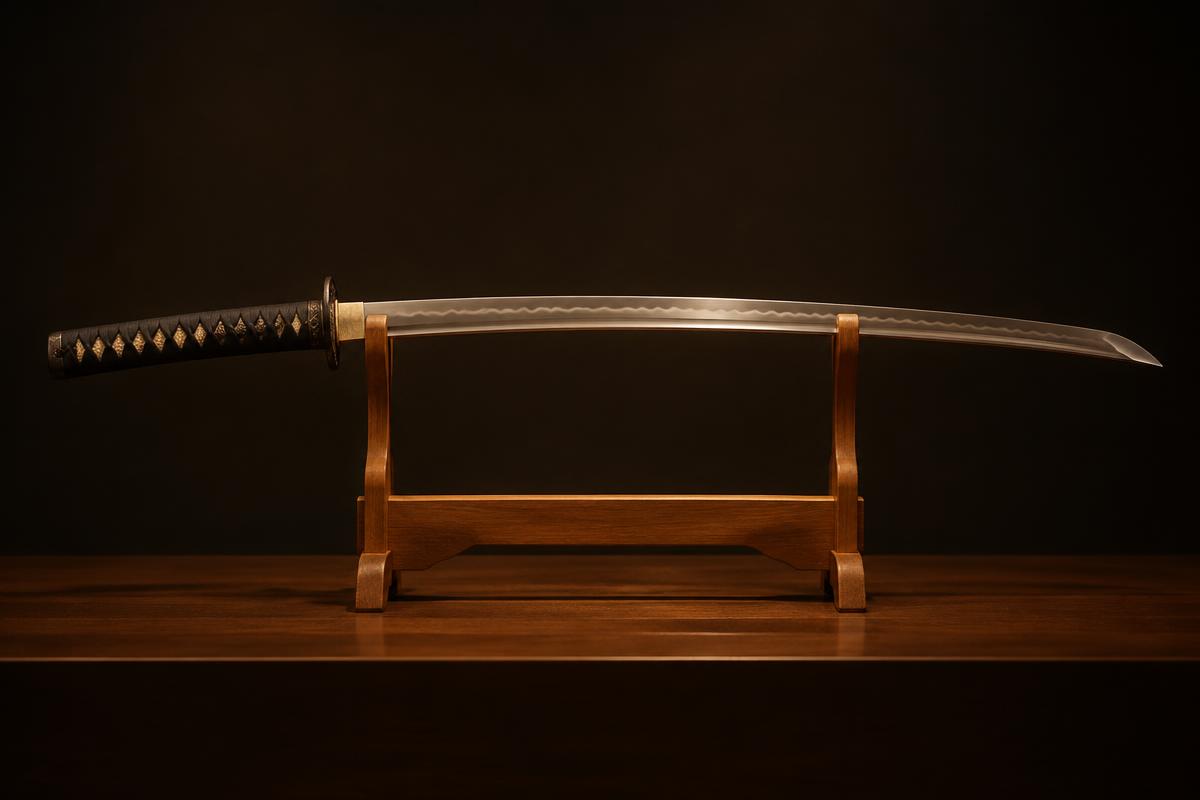
From straight swords to curved blades
Early Japanese swords were straight and influenced by continental Asian designs. Curved blades emerged around the late Heian period; historians debate the precise reasons, with mounted warfare often cited [1][2].
Tachi and katana
The tachi was slung from the belt with the edge facing down. The katana was thrust through the sash with the edge up, which allowed a fast draw-and-cut. The distinction is primarily about how the sword was mounted and worn, not just the blade [1].
Traditional construction
Descriptions above follow Kapp, Kapp and Yoshihara's account of traditional practice [3].
- Tamahagane steel is produced in a tatara clay smelter.
- The smith folds and forge-welds the steel to refine it and distribute carbon.
- A softer core may be wrapped in a harder jacket (methods vary by school).
- Clay is applied — thinner at the edge — before quenching; this produces a hard edge, a softer spine, the curvature, and the hamon.
- A specialist polisher reveals the blade's grain and hamon.
Cultural context
Japanese swords were valued as art objects as well as weapons, and many are preserved in museum collections and temples [2]. Popular claims that the katana was the 'soul of the samurai' reflect real cultural reverence, but the phrase is often used romantically; in battle, spears and bows were also central.
Frequently asked questions
How many times is a katana folded?
Accounts commonly describe around 10–20 folds, producing thousands of layers. Claims of 'thousands of folds' are a misunderstanding of layer counts.
Sources
- Encyclopaedia Britannica, “Katana”
- The Metropolitan Museum of Art, Arms and Armor collection
- Leon & Hiroko Kapp, Yoshindo Yoshihara, The Craft of the Japanese Sword (Kodansha, 1987) — print book
✍️ Found an error? Report a correction. Written and edited by the SwordPath Editorial Team; not externally expert-reviewed. See our editorial policy.