⚔️ Sword Types
Longsword vs. Katana: Key Differences and Historical Context
By SwordPath Editorial Team · Published · 9 min read
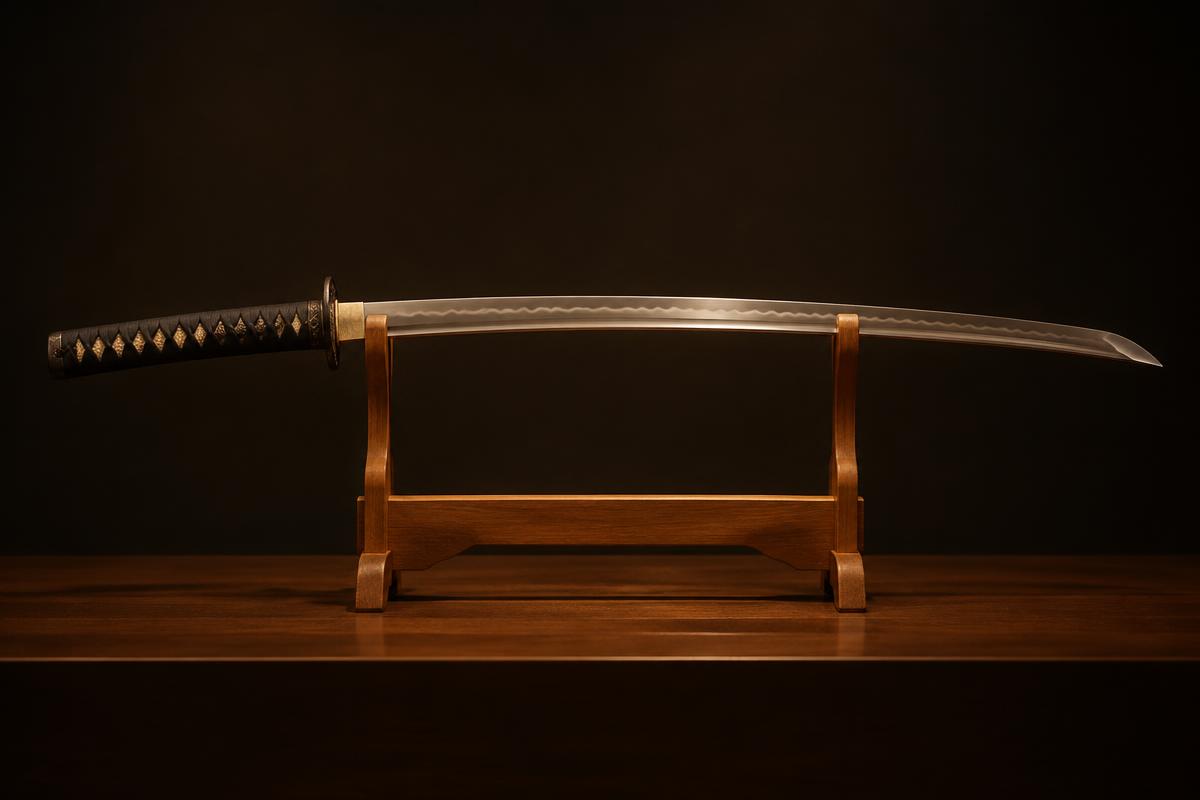
Side-by-side comparison
| Feature | European longsword | Japanese katana |
|---|---|---|
| Main period | c. 14th–16th c. | From c. 15th c. (earlier tachi before that) |
| Blade | Straight, double-edged | Curved, single-edged |
| Guard | Cross-guard (quillons) | Small disc guard (tsuba) |
| Hardening | Usually through-hardened and tempered | Differentially hardened (clay-coated) edge |
| Typical length | Roughly 100–130 cm overall | Blade (nagasa) usually over c. 60 cm |
| Typical weight | Roughly 1.1–1.8 kg | Roughly 1.1–1.5 kg |
Lengths and weights vary considerably between individual surviving examples; the ranges above are indicative of museum pieces, not specifications [1][2].
Design reflects armour and tactics
Late medieval European fighters often faced plate armour. Longsword manuals include 'half-swording' — gripping the blade with one hand to guide the point precisely into gaps [2]. The straight blade and acute point support this.
Japanese armour of the period was primarily lamellar and mail-reinforced, and the katana's curve made drawing cuts efficient. The katana was worn edge-up through the sash, which allowed it to be drawn and used quickly [3].
Myths worth retiring
- “Katanas can cut through European swords.” There is no credible historical evidence for this; any sword can be damaged by misuse.
- “Longswords were heavy and clumsy.” Surviving examples are generally well under 2 kg and well balanced [1].
- “Folding made katanas unbreakable.” Folding homogenised the traditional tamahagane steel; it did not make blades indestructible [4].
Frequently asked questions
Did samurai and knights ever fight each other?
There is no documented battle between European knights and samurai. Comparisons are therefore hypothetical.
Is a katana a longsword?
In a loose descriptive sense a katana is a long, two-handed sword, but 'longsword' as a term usually refers to the European weapon.
Sources
- The Metropolitan Museum of Art, Arms and Armor collection
- Ewart Oakeshott, The Sword in the Age of Chivalry (Boydell Press, rev. ed. 1994) — print book
- Encyclopaedia Britannica, “Katana”
- Leon & Hiroko Kapp, Yoshindo Yoshihara, The Craft of the Japanese Sword (Kodansha, 1987) — print book
✍️ Found an error? Report a correction. Written and edited by the SwordPath Editorial Team; not externally expert-reviewed. See our editorial policy.